Monday, 27 June 2016

Hamerkop Lunchtime

I photographed this hamerkop (Scopus umbretta) eating what I think is a guttural toad (Amietophrynus gutturalis) at the Durban Botanical Gardens' lake. Hamerkop is Afrikaans for hammer (hamer) head (kop) which is quite appropriate.

It had already stabbed the toad with its beak to kill it a couple minutes before and was throwing it in the air to align it with its beak so as to swallow it. It had tried quite a few times already so this wasn't as lucky a photo as you might think, although this was the occasion it got it right. It lowered the toad into the water each time again before trying again which accounts for the water spray off the toad.


When I was a teenager and at school my mother found a hammerkop eating my goldfish as she was walking through the garden on her way to work in the school's tuck-shop. She chased it away but it just landed on the roof and waited. So my mother got an umbrella hoping to use it as a scarecrow, but the hammerkop didn't think much of it and landed right next to the umbrella and she had to leave. I think I lost 72 goldfish. 

I learned much later to stop keeping goldfish and rather to stock fast breeding small fish I didn't care much about. Then you can rather enjoy the wildlife that come to eat the fish than trying to work against them.

My neighbour who gave me the advice also gave me the fish by scooping a bucket-load out of his pond. The fish were black and slim so they stood a decent chance of hiding in my pond which was very deep with lots of plants. The most interesting outcome was that fishing spiders started living in the foliage in the pond.

It is quite a big bird at around 50cm tall and obviously isn't shy about stabbing things, but this didn't stop my daft 9 month old cat from trying to stalk one on an open lawn while the bird was next to my fishpond. The bird wasn't even bothered with me standing fairly close by. The hamerkop turned its head to focus on the leopard crawling cat and stood there for a while as if it couldn't believe it, then walked away while looking at the cat, flying off after a bit when the cat didn't give up.

We often had hadeda ibis (Bostrychia hagedash) in our garden which are a bit bigger than a hamerkop and have equally stabby beaks. They use them to punch into the ground and grab earthworms and insects. Our cat totally ignored them so I wonder if he had become older and wiser, that they were too big or that they were rarely alone put him off.


Wednesday, 22 June 2016

Bar-throated Apalis


I can highly recommend it as a place to visit & stay, although you should have a car with high ground clearance.

I used to drive there in a VW Golf -- the original box-shaped one, very, very slowly with one wheel in the middle of the road and the other on the side of the road to avoid for the deep ruts. On one occasion going home from the lodge on the mountain top, after perhaps a 40 minute crawl, I reached the tarred main road which has a 100kph speed limit and accelerated. My wife shouted at me to not drive so fast ... I was only doing 60!

There is another lodge in the forest which has 4 (5?) rivers to cross. My golf happily splashed across all of them except the last one on the return journey. It always hit a rock with the underside, I could never find the rock and it never hurt the car. :-)

My next car had high ground clearance and I drove the route normally at a reasonable speed, but the first salesman lost the deal because he insisted I needed a 4x4 :-) I guess he never saw the Top Gear episode where the backup car, an old VW Beetle made it right across Botswana.

Monday, 20 June 2016

African Spoonbill in Flight

An African spoonbill (Platalea alba) in flight over the Durban Botanical Gardens.


They are commonly seen around the lake there as are:
The last three are commonly seen at the lake, while the previous ones are probably always there as they breed in the gardens. Kingfishers can be seen at the lake diving for prey, but I only saw them occasionally.

There a lot of other birds to be seen in the Garden in general and I can highly recommend it as a place to visit. 

Thick-billed weavers (Amblyospiza albifrons) used to be common as they bred in the reeds on the sides of the lake but the Garden cleared the reeds a few years ago and I haven't seen them there since. There also used to be a lot more Sacred Ibis but they pruned the trees they favored for nest building.


Monday, 13 June 2016

Spur-winged goose


I photographed this spur-winged goose (Plectropterus gambensis) having a bath in the Durban Botanical Garden's lake. They are related to geese but despite their common name they have enough anatomical differences that they are in their own sub-family Plectropterinae.


Sunday, 12 June 2016

Pink-Backed Pelican Fun

In South Africa Pink-backed Pelicans (Pelecanus rufescens) are only found in Kwazulu-Natal. One of the easiest places to see them is at the lake in Durban's Botanical Gardens where they roost at night in the trees around the uphill side of the lake. This is one of only three breeding colonies of this pelican species in South Africa.

The lake is also home to African Helmeted Turtles / Marsh Terrapins (Pelomedusa subrufa). I had previously seen Sacred Ibis walk up to a turtle on land and bang its shell with its beak for a bit while the turtle waited for the indignity to stop tucked away in its shell, before marching onward.

While watching the pelicans one weekend, one of them started playing with a object, throwing it up into the air and then catching it with its beak. As the object went up it would spiral around making a Catherine Wheel of water while the pelican would paddle into place to catch it.

I couldn't make out what the toy was but it was about the size of a turtle. The pelican played around for a few minutes allowing me to get some fantastic photos, but while worrying about the poor little airborne creature.

When I got home and looked at the photos it happily turned out that the object was actually the old seed cup from a Sacred Lotus flower (Nelumbo nucifera) which grow on the one side of the lake.


I was lucky to have this photo and 7 others chosen in a bird photography competition held by Birdlife KwaZulu-Natal to form part of the 30 to be displayed in an exhibition at the Durban Natural History Museum in October 2010. 

Turtle, Terrapin or Tortoise?

While reading up on the turtles/terrapins for this post I found that the turtle versus terrapin versus tortoise common name usage is far more unusual than I had thought. I had often called these turtles with someone correcting me to terrapin, although as you can see from the common names of this particular species both terms have been used. As an example of the strangeness, seemingly in Australia where there are no indigenous land-dwelling tortoises, all the freshwater turtles are called tortoises.

Monday, 29 February 2016

Purple-crested Turaco (Lourie)

While growing up I never saw louries (turacos) in our garden, but over time the bird populations changed and for about the last ten years I lived there Purple-crested Turacos (Tauraco porphyreolophus) often visited our garden.  I saw two together fairly often so there was at least a pair of them.

Their call is an unmistakable repeated kok-kok-kok sound which my wife describes as laughing. They are shy and fly from tree-to-tree, hopping between the branches, mostly hidden in the foliage. When they fly their crimson red flight feathers are dazzling.

With their loud call you are left in no doubt about where they are. However trying to see them for a good photograph with hopefully all of the bird and not in dark shade drove me crazy. I finally got some decent pictures when one stayed out in the open on an old avocado pear tree for a moment, rather than buried in our enormous Forest Natal Mahogany Tree (Trichilia dregeana).


Friday, 26 February 2016

Helmeted Guineafowl

Helmeted Guineafowls (Numida meleagris) are common in South Africa, this particular one photographed, like the previous few posts, in the West Coast National Park. I love their spotty plumage.


Origin of the names


The origin of the name guineafowl and it's species name meleagris is interesting.

The guineafowl was domesticated in classical times in Greece and were called melanargis meaning black & silver which was corrupted to meleagris.

They were distributed throughout the Roman Empire as were the Moroccan Guineafowl subspecies (N. m. sabyi). The Romans also called the former species meleagris and the latter the numidian fowl or hen. N. m sabyi has possibly been extinct since the 1950s.

Both disappeared from Europe after the Roman Empire declined. Guineafowls were rediscovered by the Portuguese explorers on the west coast of Africa in the late 16th century which is where they get their modern common name guineafowl

The naming of the wild turkey from North America (Meleagris gallopavo) intertwined with the guineafowl (Numida meleagris) but from what I've read it seems rather murky with multiple theories.

They both share the word meleagris, one as its genus the other as its species. The guneafowl obviously had that name first, but the puzzle is why did the turkey get it too. One theory is that they appeared in the European market at around the same time with resulting confusion.

While the scientific name link is obvious, the common name turkey doesn't escape either.

One theory is that merchants from the Ottoman Empire traded in guineafowl and that the birds got a nickname of turkey. Settlers in North America saw what seemed to be similar birds and then called them turkeys. Another theory is that merchants from the East also sold turkeys later... A further theory on Wikipedia is that they were named turkeys just because it was an exotic place like Guinea which seems unlikely, but I suppose weirder name choices have been made with less basis.

References


Turkey name theories:
  1. The flight of the turkey, The Economist, 20th December 2014
  2. Guinea Fowl, Roy Crawford in Poultry Breeding and Genetics Elsevier, Amsterdam, 1990
  3. http://www.npr.org/templates/story/story.php?storyId=97541602
  4. Helmeted Guineafowls, Wikipedia
  5. Wild Turkey, Wikipedia
Other:
  1. Guinea Fowl, Roy Crawford in Poultry Breeding and Genetics Elsevier, Amsterdam, 1990
  2. Extinct Birds, Julian P. Hume, Michael Walters, 19 Feb 2012
  3. Helmeted Guineafowls, Wikipedia
  4. BirdLife International, Helmeted Guineafowl Numida meleagris

Yellow Bishop

Here is another bird photographed in the West Coast National Park in South Africa. It is a Yellow Bishop (Euplectes capensis) which is a species of weaver (Ploceidae).


Thursday, 25 February 2016

Bokmakierie

A Bokmakierie (Telophorus zeylonus) in the West Coast National Park with an insect. Bokmakieries are a species of bushshrike endemic to Southern Africa.

The West Coast National Park is a very beautiful nature reserve about an hour's drive from Cape Town. It borders Langabaan Lagoon on the one side and the Atlantic Ocean on the other. The best time to visit is in August or September when the flowers are in full bloom and the private land north of the reserve is opened for visitors.


Praying Mantis

This impressive praying mantis was hanging onto the top of a window-frame. I'm not sure what it is but it looks like one of the African Stick Mantis species (Hoplocorypha)

There are more than 200 species of mantis in sub-Saharan Africa.


Sunday, 14 February 2016

Common Hairtail Butterfly

I photographed this Common Hairtail butterfly (Anthene definita definita) drinking water and minerals from the mud on a farm road in the Karkloof Mountains. Its wingspan is between 25-28mm.

A good tip I learn't when I was a kid photographing my dog was to always photograph animals at their level -- even if that sometimes means lying down in the mud in a tractor rut, or in the case of my dog being pounced upon and having my face licked.


Saturday, 13 February 2016

Phantom Flutterer

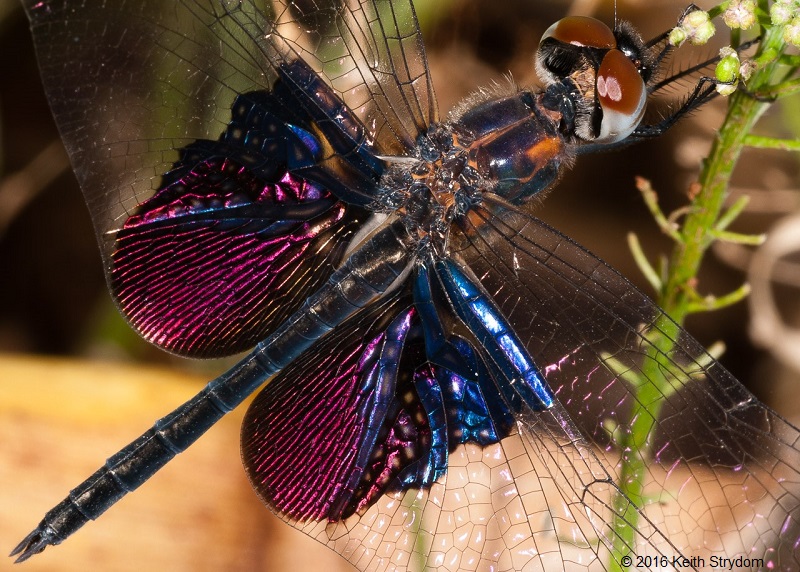
The Phantom Flutterer (Rhyothemis semihyalina) is a very beautiful dragonfly that occurs throughout Africa, the Indian Ocean islands, part of the Middle-East and part of southern Asia.

The iridescent purple is fantastic - the close-up photograph beneath this one shows it better although a photo doesn't do it enough justice. I've rarely seen this dragonfly but I was lucky enough to photograph this one right next to my front door. I can sprint for a camera quite fast!


Friday, 12 February 2016

Gaudy Commodore Butterfly

This is a Gaudy Commodore butterfly (Precis octavia sesamus) in its winter form photographed in my garden. Its summer form is red with black markings.

It's a large butterfly that I've always found hard to photograph as it's quite skittish (well at least around me!) unless you come across it early in the morning while it's still cold outside.


Friday, 5 February 2016

Moss under a Microscope

Moss from a path in my garden under a microscope with grains of fine sand. This photo was taken with a USB microscope I bought from Adafruit that I used to inspect circuit boards.

My father has now adopted it as it turns out it is brilliant for looking at postage stamps for the little differences that philatelists need to spot. All his friends at his stamp club have been buying USB microscopes since he showed them. Better to look at a nice large screen than squint through a magnifying glass...

A circuit board using the same microscope at a lower magnification: